
Skip to content
Wild10
Hunting broadhead points showing cutting edges

Archery gear · Arrow spine

Spine: the one number you cannot buy your way around

An incorrectly spined shaft cannot be fixed by better shooting, a better bow, or a better broadhead. Get the number first.

Shot off the shelf, an arrow has to bend around the riser to fly straight — the archer's paradox. Too stiff and it cannot flex clear; too weak and it slaps the riser. Neither error can be tuned out with the bow, which is why spine is the first purchase decision, not the last.

The number you need comes from four variables: your actual draw weight at your draw length, arrow length, point weight, and whether you shoot off a shelf or a cut-past-center rest. Calculate it, then prove it with a bare shaft.

Inputs
4 numbers
Confirm with
Bare shaft, 15 yd
Wood shafts
Pound-test ranges
Carbon shafts
.340–.700 deflection

01

Common spine starting points

Carbon shafts, 125 grain point, 29 inch arrow, off the shelf. Verify with the chart tool — draw length and point weight move the answer a full group.

Actual draw weightStarting carbon spineWood shaft range
35 lb.600–.70035–40 lb
40 lb.60040–45 lb
45 lb.50045–50 lb
50 lb.50050–55 lb
55 lb.400–.50055–60 lb
60 lb.40060–65 lb

02

The levers that move spine

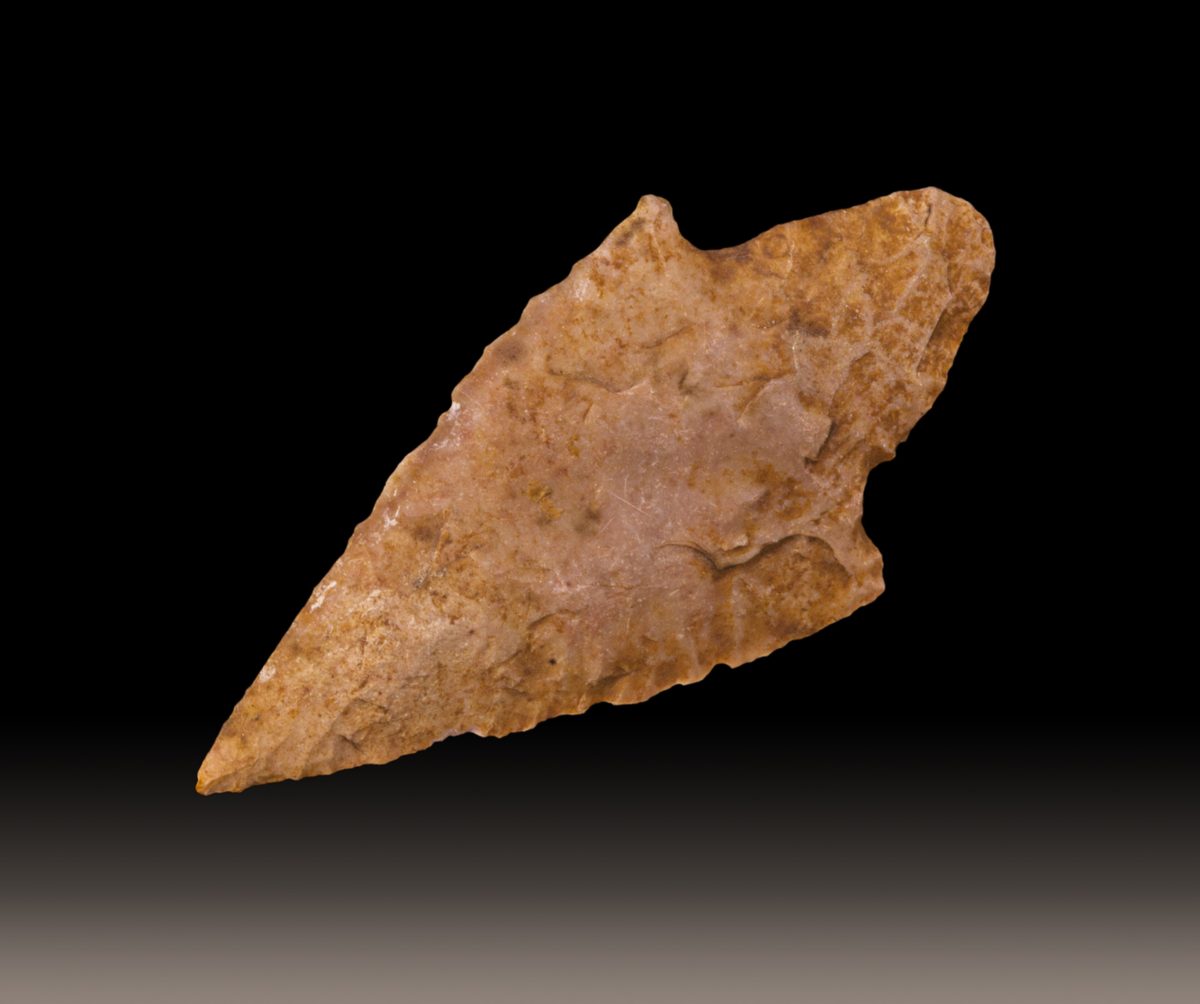
Hunting broadhead points showing cutting edges
Unknown photographer / Wikimedia Commons · Wikimedia Commons

Point weight

The easy lever

Adding front weight makes a shaft behave weaker without changing its static rating. A 200 grain head can pull a stiff .400 into tune — and raises FOC and penetration at the same time, which is why heavy heads are the traditional hunter's favorite adjustment.
Arrow length

Cutting stiffens

A longer shaft flexes more and behaves weaker; cutting an inch stiffens effectively. Leave one inch of clearance past the shelf regardless — a broadhead drawn behind the shelf is how bowhands get cut.

Draw weight at your draw length

Not the sticker

Bows are marked at 28 inches. You pull roughly 2.5 lb more per inch over and less per inch under. A 50 lb bow at a 30 inch draw is a 55 lb bow for spine purposes — use the real number.

03

Then prove it

Every spine chart is a starting point; your release is the final variable. Shoot a bare shaft next to a fletched arrow at fifteen yards, read the impact angle, and adjust point weight first, then length, then brace height. The bare-shaft tuning guide walks the full sequence.

Questions

Frequently asked

What spine do I need for a 50 lb recurve?
For a 50 lb recurve at a 28 inch draw with a 29 inch arrow and 125 grain point, start with a .500 carbon shaft. A 30 inch draw or a 200+ grain hunting point usually moves you to .400. Run your real numbers through the spine chart tool.
Do wood and carbon arrows use the same spine numbers?
No. Carbon uses deflection numbers like .500; wood is sold in pound-test ranges like 50–55 lb. Match the wood range to your calculated draw weight, then add about 5 lb of spine per inch of arrow past 28 inches and per 25 grains of point weight over 125.
Can I tune an arrow that is too stiff?
Yes, within a range: add point weight in 25 grain steps, lengthen the shaft, or raise brace height slightly. If the bare shaft still prints stiff after those levers, the shaft is simply wrong — no tuning fixes a spine that is two groups off.

Also on The Wild10

Fishing Guides

Fish identification, the knots that hold, lure selection by conditions, and the habits that fill a stringer.

Open the fishing hub →
Fly angler casting on a clear northern river