


Winter
- Days
- 15–35°F
- Nights
- -5–22°F
The season this pursuit exists for: deep snow, short days, real avalanche terrain.
- Avalanche slabs after storms and wind loading
- Frostbite in wind chill
- Whiteouts destroying navigation
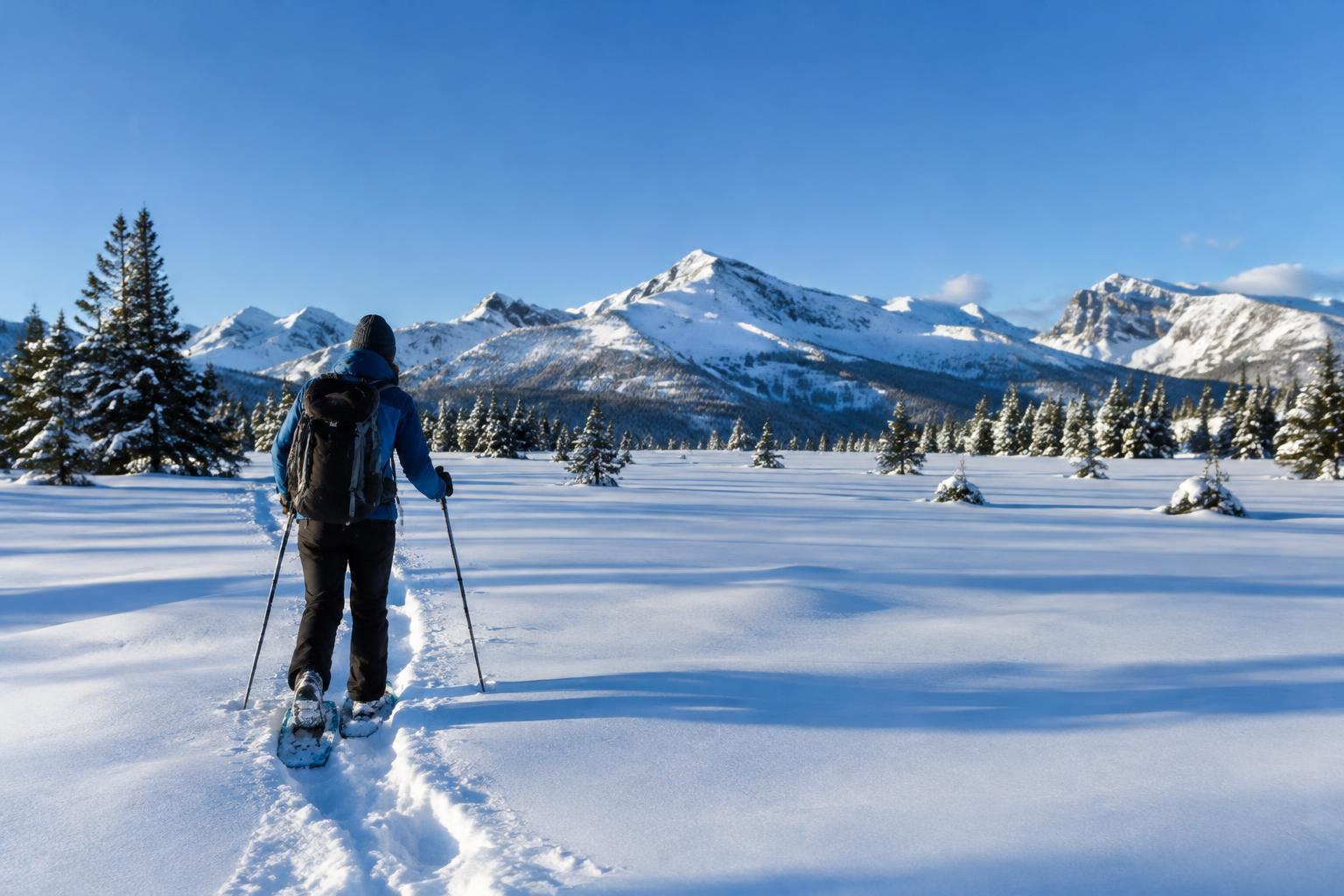
Snowshoeing has the shortest learning curve of any winter pursuit: if you can hike, you can snowshoe. The skill is in cold management and route choice, not technique.
Season: Any time the snow is deeper than your boots.
Snowshoeing turns summer trails into quiet winter routes. It's easy to learn, but cold, short days and avalanche terrain still need planning.
Stick to low-angle terrain away from avalanche paths unless you've had avalanche training.
Packed trails, rental snowshoes, short loops.
Breaking trail, longer days, poles and traction choices.
Winter camping, avalanche training, steeper terrain.
Choose snowshoe size by total weight with pack and by snow type — bigger floats better in deep powder.
Kick steps and use heel lifts on steep climbs; poles add balance on traverses.
Keep knees soft, weight back slightly and plant heels first.
Snow hides trail markers — carry a map and know the route, as tracks can drift over.
Mid-winter gives deep snow and short days; spring gives firmer snow early in the day and softer, slushy afternoons.
Sources: Avalanche.org — Forecasts and danger scale · National Park Service — The Ten Essentials
Our Top 10 lists for the kit this pursuit leans on, each with real product photos.

Proven cold-weather canoeing gloves and mitts evaluated for thermal insulation, paddle grip, waterproof protection, and cockpit dexterity.

Synthetic insulated jackets provide reliable warmth when wet. We analyzed leading independent reviews to rank the top 10 options for thru-hiking, alpine climbing, and everyday outdoor use.

A research-backed guide to the best women's winter boots for deep snow, icy hikes, and freezing everyday slush, synthesized from leading independent outdoor tests.

We synthesized expert field testing and consensus awards to rank the 10 best insulated vests and midlayers for staying warm, dry, and mobile in cold weather.

A definitive guide to the best ski gloves and mittens, comparing warmth, weatherproofing, and dexterity across top-rated cold-weather handwear.

Field-proven snowshoes ranked by traction, flotation, frame durability, and value, synthesizing cross-industry testing and backcountry expertise.

Alberta, Canada
Kananaskis Country offers a diverse array of ice climbing opportunities, ranging from easily accessible single-pitch flows to serious multi-pitch alpine routes, all within an hour or two's drive of Calgary.

Minnesota, United States
Over a million acres of interconnected lakes and portages.

Maine, United States
A traditional New England wilderness river with campsites, portages, and a strong outfitter scene.

Nepal, Nepal
The full route is expedition-scale; sections like Manaslu or Kanchenjunga are trip-of-a-lifetime treks.

Wyoming, United States
The Gros Ventre Wilderness, located southeast of Jackson Hole, offers a magnificent blend of towering peaks, lush river valleys, and extensive timbered slopes.

Montana, United States
HD 210 plunges hunters into the heart of the Bob Marshall Wilderness Complex, offering an unparalleled backcountry elk experience.

California, United States
340 km through California's High Sierra, from Yosemite Valley to the summit of Mount Whitney.

Wyoming, United States
The North Absaroka Wilderness, stretching north from Cody towards the Montana border, is a rugged and remote expanse of volcanic plateaus, deep canyons, and high ridges.

Washington, United States
These rivers, fed by ancient glaciers and abundant rainforest precipitation, represent the pinnacle of wild winter steelhead fishing in the Pacific Northwest.
January through March for reliable snowpack; late-season corn in April rewards early starts.
The season this pursuit exists for: deep snow, short days, real avalanche terrain.
Corn cycle: firm mornings, soft afternoons, and a hard turnaround time.
Early-season snow over rocks and stumps — thin cover, high consequence.
Snow is limited to permanent fields and high glaciers.
See live conditions and seasonal averages the same way destination pages show them.
Browse the destinations mapPlanning ranges are typical temperate-latitude values — always verify the forecast, flow, avalanche, and fire advisories for your specific area and elevation before you commit.
Every link below opens a planner already set to snowshoeing — the right trip type, temperature band, checklist and builder, so your kit starts from the skills and hazards this pursuit actually demands.

When spring snow turns slick and you only carry trekking poles, your body mechanics must do the work of steel. Here is how to arrest a slide using friction and poles.

A quinzhee isn't just a pile of snow; it's an engineered structure. Understand the science of snow sintering, crystal bonds, and catenary arches to build a safe, strong shelter that won't collapse on you.

When temperatures plummet, your choice of stove fuel isn't just about convenience—it's about survival. We break down the realities of white gas and isobutane for melting snow in sub-zero conditions, diving into fuel mass, efficiency, and real-world performance.

It's easy to build a snow shelter, but how well does it really protect you in high-elevation cold? We've measured the internal temperatures, 'cold well' efficacy, and wall insulation of various designs to cut through the theory and get to the practical reality of heat retention.

Learn shoulder season backpacking through a practical sequence, common failure points, a controlled field drill, gear notes, and the safety checks that should happen before a real backpacking trip.

Learn shoulder-season snow mistakes through a practical sequence, common failure points, a controlled field drill, gear notes, and the safety checks that should happen before a real backpacking trip.
Plan for roughly half your summer hiking pace, and less than that when breaking trail in fresh deep snow.
Any insulated waterproof boot that fits the binding works. Gaiters matter more than the boot brand.