


Summer
- Days
- 72–92°F
- Nights
- 50–65°F
Warm water, long evenings, forgiving swims — the season most paddlers plan around.
- Afternoon wind on lakes and bays
- Thunderstorms with nowhere to shelter
- Low, bony flows on rain-fed rivers
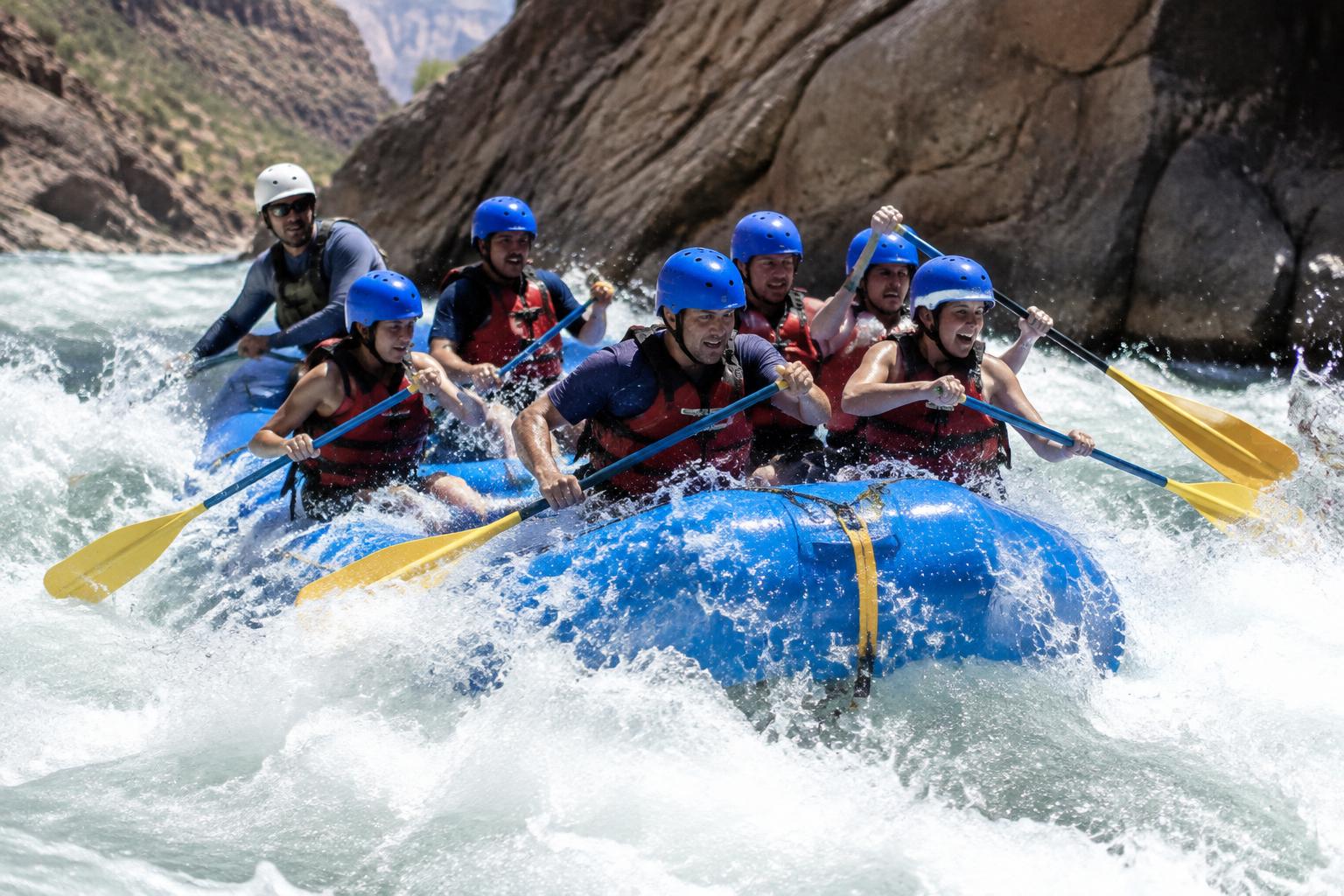
Rafting turns a river into a floating basecamp. You can carry coolers, kitchens, and groovers through canyons no other craft can supply — as long as the rigging and the safety system are right.
Season: Snowmelt peaks in spring; permitted canyon seasons run into fall.
Rafting is the friendliest way into whitewater — a commercial trip lets you feel the river while a guide makes the calls. Private trips demand rigging, rescue and river-reading skills.
Multi-day river trips often need lottery permits; plan a year ahead.
Guided Class II–III day trip; learn paddle commands and swimmer position.
Guided multi-day trip, swiftwater rescue training, learn to row.
Private permitted trips, trip leadership, bigger water.
Learn forward, back, left/right turn, stop and 'get down' before launch, and react instantly.
Sit on the outside tube with feet wedged, and keep the T-grip covered with your hand to protect teeth.
Defensive swim on your back, feet downstream; swim aggressively to shore or the raft once out of the rapid.
If the raft pins on a rock, move everyone to the downstream side to keep it from flipping or wrapping.
Spring melt brings the biggest water and the coldest swims; mid-to-late summer flows suit families and first-timers.
Sources: American Whitewater — International Scale of River Difficulty · American Whitewater — Safety Code · U.S. Coast Guard — 2024 Recreational Boating Statistics
Our Top 10 lists for the kit this pursuit leans on, each with real product photos.

Find the best bushcraft pants. Built with heavy canvas, waxed hybrids, or wool, featuring reinforced knees and ember resistance for hard camp work.

Full-tang and stick-tang blades that earn their place around a working camp.

Life jackets you'll actually wear all day — fitted, vented, and matched to how you paddle.

Folding saws, bucksaws and pull-stroke monsters that turn deadfall into firewood faster than any axe.

From belt hatchets to full felling axes — the working range for camp and shelter craft.

From rainforest-fed coastal gems to vast inland waterways, these rivers offer the region's best chances at encountering wild summer and winter steelhead.

Minnesota, United States
Over a million acres of interconnected lakes and portages.

Maine, United States
A traditional New England wilderness river with campsites, portages, and a strong outfitter scene.

South Island, New Zealand
Rainforest walls, waterfalls by the thousand, and New Zealand's most serious multi-day tracks.

Ontario, Canada
Ontario's canoe wilderness — a thousand lakes, portage trails, and no motors anywhere.

Minnesota, United States
Whitewater State Park, located in Winona County, is a prime example of Minnesota's Driftless and offers excellent bowhunting opportunities within designated zones.

Minnesota, United States
Similar to the Knife Lake route, this trip leverages the Moose Lake entry point and towboats to shorten the initial paddle, but aims for Basswood Lake.

Manitoba, Canada
Classic Canadian Shield river — pictographs, whitewater, and a real sense of scale.

British Columbia, Canada
116 km loop through connected lakes — the rare wilderness paddle you can do without a shuttle.

Indiana, United States
This route takes you into the heart of some magnificent BWCA scenery with relatively short portages, ultimately leading to the expansive Crooked Lake.
June through September, once water temperature is high enough that a swim is survivable without a wetsuit.
Warm water, long evenings, forgiving swims — the season most paddlers plan around.
Big water and empty rivers — the strongest flows and the coldest swims of the year.
Quiet water and superb light, with water temperatures dropping faster than the air.
Drysuit-only territory with ice on gear, ramps, and hands.
See live conditions and seasonal averages the same way destination pages show them.
Browse the destinations mapPlanning ranges are typical temperate-latitude values — always verify the forecast, flow, avalanche, and fire advisories for your specific area and elevation before you commit.
Every link below opens a planner already set to whitewater rafting — the right trip type, temperature band, checklist and builder, so your kit starts from the skills and hazards this pursuit actually demands.

How you load your packraft isn't just about fitting gear; it profoundly affects performance. This deep dive compares internal tube storage with deck-bag placement, examining their impact on draft, tracking, and capsize recovery.

Moving bulk from your packraft's bow deck to internal cargo tubes can be a game-changer for stability and wet-entry recovery on Class III wilderness rivers. Here's why.

Staying hydrated in deep winter is critical, yet challenging. This guide breaks down the physical mechanics and practical techniques for keeping your essential three liters of water from freezing solid when temperatures plummet below zero.

When the coastal rainforest has absorbed weeks of rain, finding dry fuel for a fire can feel impossible. This guide cuts through the wet to show you where to look, what to use, and how to process materials for a successful blaze, even in the soggiest conditions.

Based on a decade of Alone, we dissect the bushcraft skills that separate the finalists from the early tap-outs. This isn't just about survival; it's about thriving in isolation.

The best bushcraft knife is not the largest, hardest, or most expensive blade. It is the knife that fits your hand, matches your legal and practical needs, holds an appropriate edge, and can be controlled through repetitive work. Steel matt

Thirty days is enough to create momentum, not mastery. A useful bushcraft challenge focuses on short, repeatable sessions, measurable standards, and safe progression. It should improve systems you will actually use outdoors rather than prod

Bushcraft begins with a simple promise: learn to meet ordinary needs outdoors with skill, judgment, and a modest kit. It is not a shopping contest, a costume, or a race to build a log cabin before lunch. Beginners improve fastest when they

Foraging can deepen ecological knowledge, but it is a poor place for improvisation. Some toxic plants and fungi resemble edible species, allergies and contamination complicate identification, and harvest rules vary. The safe approach is spe
As a paddle-crew guest, yes — Class II–III commercial trips are approachable. Rowing your own boat is a multi-season apprenticeship.
It depends on the run, but rising water and debris in the current are a universal signal to wait a day.