


Summer
- Days
- 72–92°F
- Nights
- 50–65°F
Warm water, long evenings, forgiving swims — the season most paddlers plan around.
- Afternoon wind on lakes and bays
- Thunderstorms with nowhere to shelter
- Low, bony flows on rain-fed rivers
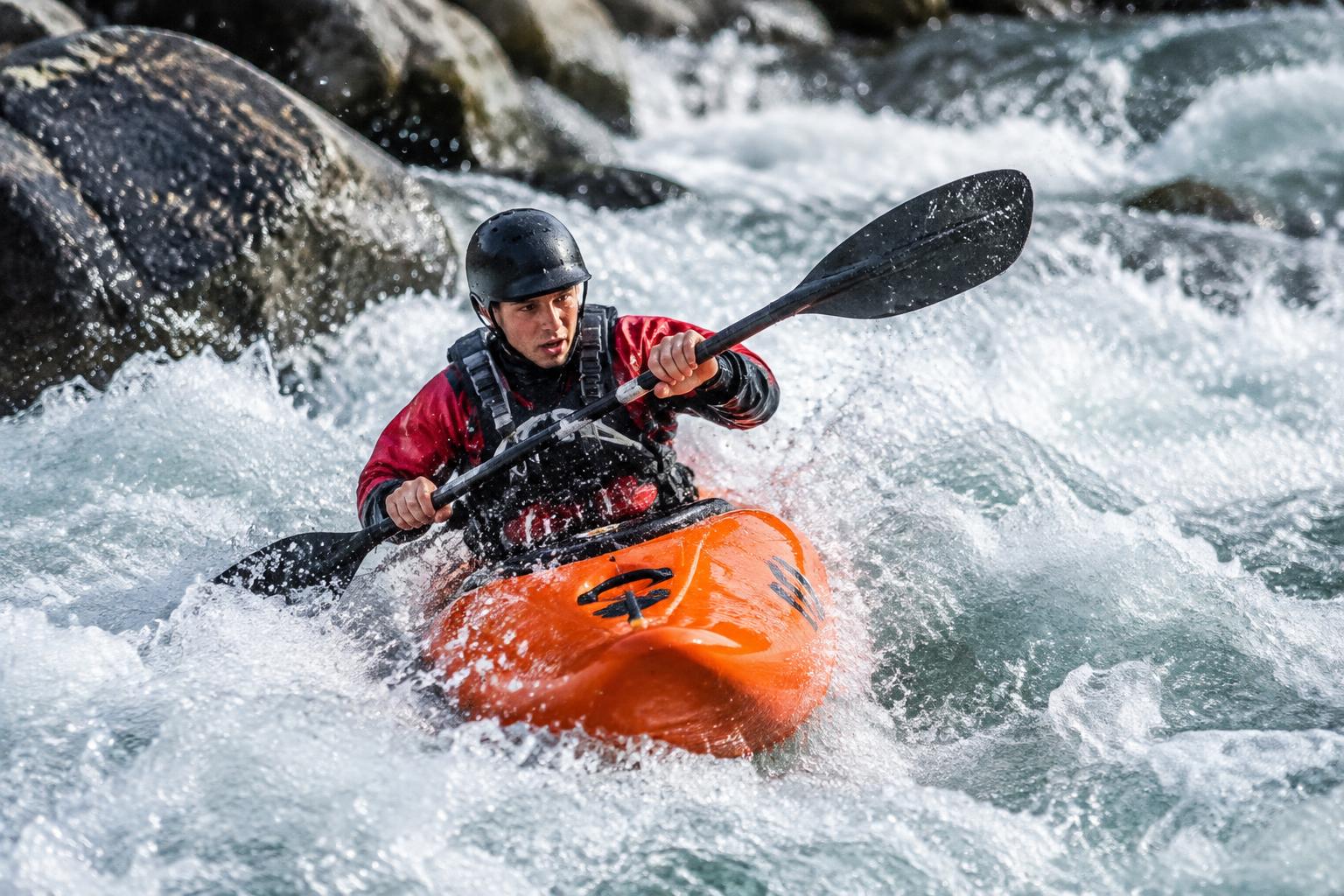
Whitewater kayaking is the most technical way to travel a river. Progress is gated by two skills: a reliable roll and the ability to read water before you're in it.
Season: Spring melt through summer dam releases.
Whitewater kayaking is a skills sport first. A reliable roll, good reading of current and solid rescue skills matter far more than the boat you buy.
Learn with a club or certified instructor and paddle with people who know the river — never solo while you're learning.
Pool roll sessions, Class I–II with instruction, eddy turns and ferries.
Combat roll on Class II–III, swiftwater rescue course, scouting rapids.
Class IV, creeking, multi-day self-support with an experienced crew.
Learn it in a pool with an instructor, then practise in moving water until it's reliable. A roll you can't do in current isn't a roll yet.
Enter and leave eddies with speed and edge, and ferry across current at an upstream angle.
Downstream V's mark the line; upstream V's mark rocks. Scout anything you can't see the bottom of.
Take a swiftwater rescue course and carry a throw bag, knife and whistle on every run.
Snowmelt brings big spring flows; summer and fall flows drop, often making for friendlier learning water.
Sources: American Whitewater — International Scale of River Difficulty · American Whitewater — Safety Code · National Weather Service — Cold water safety
Our Top 10 lists for the kit this pursuit leans on, each with real product photos.

A definitive guide to the top bike helmets for road, trail, and downhill riding, evaluated on real-world protection, ventilation, weight, and long-term value.

The best climbing helmets balance critical impact protection, ventilation, and weight. Here are the top 10 models for cragging, alpine routes, and ski mountaineering.

A data-backed guide to the best recreational, touring, sit-on-top, and folding kayaks, evaluated on hull design, stability, build quality, and real-world utility.

We synthesized expert testing and long-term durability data to rank the ten best ski and snowboard helmets for resort laps, backcountry tours, and park riding.

Paddles ranked on swing weight, blade flutter, and grip comfort after eight hours of paddling.

Packable kayaks for lakes, rivers, fishing, and paddlers without roof racks or garage space.

South Island, New Zealand
Rainforest walls, waterfalls by the thousand, and New Zealand's most serious multi-day tracks.

Minnesota, United States
Whitewater State Park, located in Winona County, is a prime example of Minnesota's Driftless and offers excellent bowhunting opportunities within designated zones.

Idaho, United States
While often associated with Idaho, the Lower Main Salmon's proximity and similar character to many PNW wilderness rivers make it a worthy inclusion.

Washington, United States
The White Salmon River, particularly the segment from Husum to the Columbia, is a quintessential PNW whitewater experience.

Oregon, United States
The Lower Deschutes, from Warm Springs or Maupin down to the Columbia River, offers a classic multi-day whitewater trip through a high desert canyon.

United States, United States
The Grande Ronde offers a classic multi-day wilderness float through a remote and beautiful canyon in northeastern Oregon.

Wyoming, United States
The Green River, specifically the 'Technical Run' section below Flaming Geyser State Park, is a favorite for Seattle-area rafters seeking a solid day trip.

Oregon, United States
The Lower Owyhee, especially below Rome, Oregon, is a wilderness gem.

Washington, United States
The Upper Skagit River, from Marblemount to Rockport, offers a truly scenic and generally mild whitewater experience through the North Cascades.
June through September, once water temperature is high enough that a swim is survivable without a wetsuit.
Warm water, long evenings, forgiving swims — the season most paddlers plan around.
Big water and empty rivers — the strongest flows and the coldest swims of the year.
Quiet water and superb light, with water temperatures dropping faster than the air.
Drysuit-only territory with ice on gear, ramps, and hands.
See live conditions and seasonal averages the same way destination pages show them.
Browse the destinations mapPlanning ranges are typical temperate-latitude values — always verify the forecast, flow, avalanche, and fire advisories for your specific area and elevation before you commit.
Every link below opens a planner already set to whitewater kayaking — the right trip type, temperature band, checklist and builder, so your kit starts from the skills and hazards this pursuit actually demands.

A technical guide to reading tea-colored currents, bedrock shelves, and deadfall strainers on remote, ungauged boreal rivers where mistakes carry high consequences.

River wood doesn't yield. Learn how to identify downstream strainers, read subtle surface hydraulics from water level, and bail out before passing the point of no return.

Timing, hotspots, legal approach distances, and what to actually do when a humpback surfaces beside your kayak.

Permits, orientation, seasons, transport, and the gear that actually matters for a Gwaii Haanas sea kayak trip.

A paddling day trip requires more than a boat and optimism. Water temperature, wind, current, waves, traffic, reentry ability, flotation, communication, and a return plan determine safety. Every paddler should wear a properly fitted life ja

A fishing kayak provides quiet access and low operating cost, but it is still a small craft exposed to wind, cold water, powerboats, entanglement, and capsize. Safety begins with a properly fitted life jacket worn at all times, a float plan

Moving water deserves suspicion. Depth alone does not determine risk; speed, footing, temperature, width, obstacles, downstream hazards, group strength, and the consequences of a fall all matter. The correct crossing is often a bridge, a sa

Plan a Ozark National Scenic Riverways trip around canoeing, kayaking, hiking, and camping, with a flexible itinerary, skill gates, official-source checks, gear priorities, turnaround triggers, and low-impact travel.

Plan a Ozark National Scenic Riverways trip around canoeing, kayaking, hiking, and camping, with a flexible itinerary, skill gates, official-source checks, gear priorities, turnaround triggers, and low-impact travel.
Most paddlers with a solid roll and a season of coached Class II are comfortable on Class III within a year.
No, but you need a reliable wet exit and a group that can rescue you. Build the roll in a pool over the winter.